Maytac logo
← Back to regions

Coffee Region

Western Region

Kenya Western Region is a dynamic specialty coffee frontier encompassing Bungoma, Kakamega, Vihiga, Busia, Trans-Nzoia, Kisii, and Nyamira counties. Situated between 1,400 and 1,800 meters above sea level, the region leverages fertile volcanic and red loam soils to cultivate Arabica and fine Robusta varieties. Processed using traditional fully washed methods, Western Kenyan coffees deliver a balanced acidity, medium body, and clean cup profiles featuring notes of sweet citrus, caramel, stone fruit, and spice.

Western Region

Sub-regions

5

Products

0

Collection

Premium Origin

Coffee Region

Western Region

Kenya Western Region is a dynamic specialty coffee frontier encompassing Bungoma, Kakamega, Vihiga, Busia, Trans-Nzoia, Kisii, and Nyamira counties. Situated between 1,400 and 1,800 meters above sea level, the region leverages fertile volcanic and red loam soils to cultivate Arabica and fine Robusta varieties. Processed using traditional fully washed methods, Western Kenyan coffees deliver a balanced acidity, medium body, and clean cup profiles featuring notes of sweet citrus, caramel, stone fruit, and spice.

Region Story

Kenya Western Region is establishing itself as a vital coffee-producing frontier, expanding the nation’s specialty coffee identity beyond the Central Highlands. Spanning Bungoma, Kakamega, Vihiga, Busia, Trans-Nzoia, Kisii, and Nyamira counties, the territory forms a core component of Kenya’s smallholder-dominated coffee landscape. Through targeted national initiatives—including a KSh 8 billion cherry advance revolving fund—government programs and cooperative unions are revitalizing processing infrastructure, distributing high-yielding seedlings, and empowering smallholder families across the western farming belt.

The terroir of Western Kenya is anchored by elevations ranging from 1,400 to 1,800 meters above sea level, high annual rainfall, and well-drained volcanic and red loam soils. Rich in organic matter and essential minerals, these soils provide ideal pH balances and moisture retention for steady root development and cherry ripening. The Arabica crop is dominated by traditional cultivars like Scott Laboratories SL28 and SL34 alongside disease-resistant hybrids Ruiru 11 and Batian. Additionally, lower-altitude zones such as Busia are pioneering Kenya’s specialty Robusta production.

Processing across the region’s hundreds of washing stations emphasizes meticulous fully washed standards. Selective handpicking ensures only ripe cherries enter disk pulpers, followed by 12–24 hour tank fermentations, grading channel washings, and controlled sun-drying on elevated raised beds for 7 to 16 days. Associations like the New Kenya Planters Cooperative Union (New KPCU) and regional bodies like the Gusii Farmers' Co-operative Union manage milling and marketing.

In the cup, Western Kenyan coffees offer a distinct profile characterized by balanced acidity, medium body, and pronounced sweetness. Typical flavor notes include sweet citrus, caramel, lime, apple, stone fruit, and delicate spice undertones. By combining structural traceability with agricultural diversity, Western Kenya offers specialty roasters an exceptional origin option.

Coffee Varieties of Western Kenya

Variety

Characteristics

SL28

Released by Scott Agricultural Laboratories (SAL) in the 1930s–40s. Deep root structure maximizing scarce water resources; high yields; complex cup profile with bright acidity and berry notes

SL34

Also released by SAL. Similar to SL28 but with heavier body; deep root system; thrives without irrigation

Ruiru 11

Introduced by Kenya Coffee Research Institute. Disease-resistant (CBD and CLR); high yields; early maturity — cropping after only 2 years

Batian

Released by CRI in 2010. Named after Mount Kenya's highest peak; resistant to CBD and CLR; early maturity — cropping after 2 years

K7

Traditional variety still cultivated in some Western Kenya regions; known for its adaptability


Processing Excellence

Western Kenya is committed to fully washed processing, a meticulous method that enhances clarity and complexity:

  1. Selective handpicking of only ripe cherries
  2. Cherry sorting at intake — under- and over-ripes removed by dedicated cherry clerks
  3. Pulping using disk pulpers to remove outer skin
  4. Fermentation for 12–24 hours to break down mucilage
  5. Washing through grading channels using clean water
  6. Drying on raised beds for 7–16 days, with frequent turning for even moisture

The Western Kenya Cup Profile

Western Kenya produces coffees with a distinctive and balanced flavor signature:

  • Acidity: Bright, vibrant, often citrus-forward with balanced complexity
  • Body: Medium to full, with a clean, juicy mouthfeel
  • Flavors: Sweet citrus, caramel, stone fruit, lime, cherry, apple, and spice notes
  • Finish: Sweet, lingering with caramel and brown sugar undertones

Classic Western Kenyan profile: Balanced acidity, medium body, and sweetness with sweet citrus, caramel, and stone fruit flavor notes.


For Roasters and Importers

From the volcanic highlands of Gusii to the fertile slopes of Mount Elgon, where rich volcanic soils, favorable altitudes, and a new generation of dedicated farmers converge , comes coffee that defines a rising frontier of excellence.

  • Traceability: Growing ability to trace beans to specific factories, cooperatives, and farmer communities
  • Consistency: Increasingly rigorous processing standards ensuring quality
  • Diversity: From Bungoma's production powerhouse to Trans-Nzoia's highland elegance
  • Impact: Supporting hundreds of thousands of smallholder families who are the backbone of Kenya's coffee industry
  • Untapped Potential: Western Kenya represents the next great origin for specialty coffee discovery

Key Selling Points

  1. Emerging Origin: Western Kenya is the rising frontier of Kenyan specialty coffee
  2. Exceptional Cup Quality: Balanced acidity, sweet citrus, caramel, and stone fruit notes
  3. Sustainable Production: Smallholder farmers practicing environmentally conscious cultivation
  4. Growing Traceability: From cooperative to factory to cup
  5. Diverse Offerings: Arabica and Robusta across multiple cooperatives and counties


Kenya Western Region represents the next frontier of specialty coffee production. With hundreds of thousands of smallholder farmers, fertile volcanic soils, favorable altitudes between 1,400–1,800 meters, and a commitment to fully washed processing, this region is rapidly emerging as a source of exceptional coffees.

From Bungoma's 8,098 hectares and 38,000 farmers to Kisii's 59 factories and 22 cooperative societies, from Trans-Nzoia's highland estates to Busia's Robusta revolution, every cup tells a story of revival, resilience, and rising excellence.

Sub-regions

Distinct origin blocks within Western Region

Use these sections to introduce estates, districts, washing stations, or elevation bands with dedicated imagery and more persuasive storytelling.

Bungoma County

Sub-region 01
Bungoma County

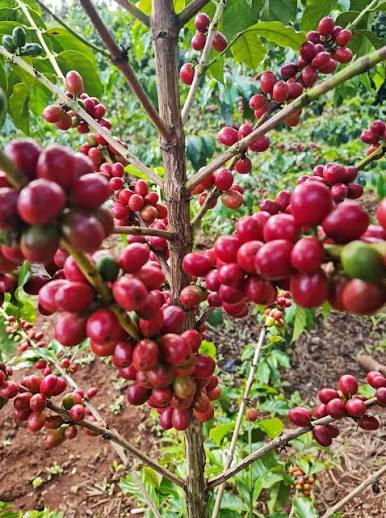
Bungoma stands as Western Kenya's coffee production leader, with an estimated 38,000 coffee farmers cultivating approximately 6,900 hectares (17,050 acres) of coffee. According to official data from the Agriculture and Food Authority, Bungoma has 8,098 hectares under coffee production, with 1,276 hectares under estate management and 6,822 hectares under cooperative management. The county produced an impressive 2,362,630 kilograms of coffee during the 2023/2024 financial year.

Soil Profile

Bungoma's soils are characterized by fertile red volcanic loams rich in organic matter and essential minerals. The region's well-drained soils provide excellent water retention properties while maintaining optimal pH levels for Arabica coffee cultivation. The volcanic origin of these soils contributes to the distinctive flavor complexity that Bungoma coffees are beginning to showcase.

Cooperative Societies and Factories

Bungoma has 52 coffee cooperative societies that collectively earned farmers Sh1 billion annually from coffee farming. Key cooperative structures include:

  • Bungoma Coffee Cooperative Union — The apex organization representing coffee growers across the county
  • Mt. Elgon Coffee Farmers Cooperative Union — Representing key coffee-growing communities in the region
  • Chepkube Cooperative (XDA 004) — Has shown remarkable quality improvements in the 2024/2025 season
  • Kimama Cooperative (XDA 039) — Demonstrated significant quality enhancement compared to previous seasons
  • Chesiro Farmers Cooperative Society Ltd — Serving farmers in Chesiro Village
  • Tigania North Farmers Cooperative Society Ltd — Another key cooperative in the county

The county government has assisted growers in forming 304 cooperative societies, demonstrating the strong cooperative movement in Bungoma.

Varieties

Farmers in Bungoma cultivate SL28, SL34, Ruiru 11, and Batian varieties, with the traditional SL varieties remaining the backbone of quality production.

Processing

Fully washed processing is the standard method. Cherries are selectively handpicked, sorted at intake, pulped using disk pulpers, fermented for 12–24 hours, washed through grading channels, and dried on raised beds.

Cup Profile

Bungoma coffees are emerging with a balanced acidity, medium body, and distinctive sweetness. Flavor notes include sweet citrus, caramel, and stone fruit. The cup offers a clean, bright profile with beautiful clarity and complex notes of browned butter, molasses, lime, cherry, grilled grapefruit, and spice cookie.

Bungoma stands as Western Kenya's coffee production leader, with an estimated 38,000 coffee farmers cultivating approximately 6,900 hectares (17,050 acres) of coffee. According to official data from the Agriculture and Food Authority, Bungoma has 8,098 hectares under coffee production, with 1,276 hectares under estate management and 6,822 hectares under cooperative management. The county produced an impressive 2,362,630 kilograms of coffee during the 2023/2024 financial year.

Soil Profile

Bungoma's soils are characterized by fertile red volcanic loams rich in organic matter and essential minerals. The region's well-drained soils provide excellent water retention properties while maintaining optimal pH levels for Arabica coffee cultivation. The volcanic origin of these soils contributes to the distinctive flavor complexity that Bungoma coffees are beginning to showcase.

Cooperative Societies and Factories

Bungoma has 52 coffee cooperative societies that collectively earned farmers Sh1 billion annually from coffee farming. Key cooperative structures include:

  • Bungoma Coffee Cooperative Union — The apex organization representing coffee growers across the county
  • Mt. Elgon Coffee Farmers Cooperative Union — Representing key coffee-growing communities in the region
  • Chepkube Cooperative (XDA 004) — Has shown remarkable quality improvements in the 2024/2025 season
  • Kimama Cooperative (XDA 039) — Demonstrated significant quality enhancement compared to previous seasons
  • Chesiro Farmers Cooperative Society Ltd — Serving farmers in Chesiro Village
  • Tigania North Farmers Cooperative Society Ltd — Another key cooperative in the county

The county government has assisted growers in forming 304 cooperative societies, demonstrating the strong cooperative movement in Bungoma.

Varieties

Farmers in Bungoma cultivate SL28, SL34, Ruiru 11, and Batian varieties, with the traditional SL varieties remaining the backbone of quality production.

Processing

Fully washed processing is the standard method. Cherries are selectively handpicked, sorted at intake, pulped using disk pulpers, fermented for 12–24 hours, washed through grading channels, and dried on raised beds.

Cup Profile

Bungoma coffees are emerging with a balanced acidity, medium body, and distinctive sweetness. Flavor notes include sweet citrus, caramel, and stone fruit. The cup offers a clean, bright profile with beautiful clarity and complex notes of browned butter, molasses, lime, cherry, grilled grapefruit, and spice cookie.

Trans-Nzoia County

Sub-region 02

Trans-Nzoia County

Trans-Nzoia County, located in the fertile highlands near Mount Elgon, has 2,360 hectares under coffee production, with 1,974 hectares under estate management and 386 hectares under cooperative management. The county has 22 active cooperative societies and one coffee union, with at least 17,992 people deriving their livelihoods directly from coffee at the farm level.

Soil Profile

Trans-Nzoia features fertile volcanic soils derived from Mount Elgon's ancient volcanic activity. The high altitudes and rich soils contribute to the coffee's unique flavor profile and bright acidity.

Cooperative Societies and Factories

  • Nasianda Factory — Located in Kisawai at 1,700 to 1,800 meters, serving 300 active members from its 430-strong membership base. Originally established in 1973 as a land-buying cooperative, it evolved into a Farmer Cooperative Society (FCS) in 1980
  • Siboti Coffee Farmers Cooperative Society — One of the biggest coffee factories in the county with an asset base of Shs.150 million
  • Muroki Coffee Farmers Cooperative Society — The county government, in partnership with Solidaridad, has put up 100,000 capacity coffee nurseries for this society
  • Chemekere Cooperative Society, Kimabole Cooperative Society, and Chebich Cooperative Society — Active cooperatives contributing to the county's coffee production

Varieties

SL28, SL34, Batian, Ruiru 11, and K7.

Processing

Fully washed. Coffee is fermented for 12 to 24 hours and dried on raised beds for up to 14 days, with regular raking and covering during the hottest times of the day to ensure even drying.

Cup Profile

Trans-Nzoia coffees are celebrated for their pronounced acidity and complex flavors. Expect citrus, apple, and sweet caramel notes with a clean, bright finish. The high-altitude cultivation and careful processing result in exceptional cup clarity and lingering sweetness.

Kakamega County

Sub-region 03

Kakamega County

Kakamega County has been identified as a pilot region for Kenya's national coffee revitalization program. The county produced 33,470 kilograms of coffee during the 2023/2024 financial year. The government has recruited 1,200 youths across the 60 wards of Kakamega to be trained on coffee farming, with 1,700 farmers already preparing 1,400 acres in Likuyani Sub County for coffee planting.

Soil Profile

Kakamega features fertile volcanic and red loam soils with good drainage and nutrient retention. The region's soils are well-suited for Arabica coffee cultivation, providing the mineral composition necessary for quality bean development.

Cooperative Societies and Factories

Key cooperatives in Kakamega include:

  • Isukha-Iguhu Cooperative — Produced 16,529 kilograms of parchment and 600 kilograms of mbuni (unwashed coffee) in a single season, earning farmers Sh5 million
  • Kambiri Coffee Society — Actively working to improve farmer access to pulping machines

The county has 2,253 cooperative societies across all sectors, with coffee cooperatives playing an increasingly important role in the region's agricultural transformation.

Varieties

SL28, SL34, Ruiru 11, and Batian.

Processing

Fully washed. Handpicked cherries sorted at intake, pulped, fermented 12–24 hours, washed, and dried on raised beds.

Cup Profile

Kakamega coffees offer bright, vibrant acidity with clean fruit-forward notes. Expect sweet citrus, caramel, and stone fruit characteristics with a medium body and lingering sweetness.

Vihiga County

Sub-region 04

Vihiga County

Vihiga County, once an important coffee-growing area, is experiencing a remarkable revival through the National Coffee Sector Revitalisation Programme. The county produced 6,600 kilograms of coffee during the 2023/2024 financial year. Officials estimate that Vihiga requires nearly 78,000 seedlings to fully restore coffee production.

Soil Profile

Vihiga's soils are fertile volcanic loams with high organic content, excellent drainage, and optimal mineral composition for coffee cultivation. The region's climate and soil conditions produce beans with distinctive flavor characteristics.

Cooperative Societies and Factories

  • Wamondo Coffee Growers Society Limited — Established in 1955, this historic cooperative is steadily rebuilding after years of declining production and dwindling membership. Farmers now earn approximately Sh185 per kilogram, making coffee one of the most attractive cash crops
  • Bunyore Farmers' Coffee Cooperative — Encouraging collective marketing, value addition, and modern farming practices
  • Lunyerere Cooperative Society — Participating in the county's revitalization program

Varieties

Farmers are being encouraged to plant improved coffee varieties such as Ruiru 11 and Batian, which are high-yielding and disease-resistant.

Processing

Fully washed with growing attention to quality standards.

Cup Profile

Vihiga coffees feature bright acidity with clean, fruit-forward notes and a medium body. The cup offers sweetness with balanced citrus and stone fruit characteristics.

Busia County

Sub-region 05

Busia County

Busia County is positioning itself as Kenya's Robusta coffee headquarters. The government has distributed 400,000 free Robusta coffee seedlings to farmers in the county, with over 2,500 coffee farmers benefiting. Busia produced 39,580 kilograms of coffee during the 2023/2024 financial year. The county has 35 cooperatives and SACCOs that require capacity building.

Soil Profile

Busia features fertile soils well-suited for Robusta coffee cultivation. The region's warm climate and adequate rainfall create optimal conditions for Robusta production.

Cooperative Societies and Factories

  • Busia Robusta Farmers Cooperative Society (FCS) — Received 10,000 Robusta coffee seedlings to boost production
  • Busia Robusta Coffee Growers Farmers Cooperative Limited — A key player in the county's Robusta sector
  • The government plans to establish coffee milling plants in each of the 33 coffee-farming counties with support from the Kenya Planters Cooperative Union (KPCU)

Varieties

Primarily Robusta, with growing interest in Arabica varieties.

Processing

Fully washed with a focus on quality and consistency.

Cup Profile

Busia Robusta offers full body, low acidity, and bold, earthy flavors with chocolate and nutty undertones — characteristics that make it ideal for espresso blends and instant coffee production.

Products

Products From This Region

Keep the buying path close to the regional narrative with clear product links and pricing visibility.

No products linked yet.

FAQs

Answer sourcing, logistics, or profile questions directly on the page to reduce drop-off before inquiry.

What distinguishes Western Kenya coffee from Central Kenya coffee?

While Central Kenya coffees (from regions like Nyeri or Kirinyaga) are known for intense, high citric acidity and distinct savory or dark berry notes, Western Kenya coffees generally exhibit a more balanced acidity with a medium body and pronounced sweetness. Typical flavor profiles include sweet citrus, caramel, stone fruit, and spice.

Does Western Kenya produce Robusta coffee as well as Arabica?

Yes. While counties like Bungoma,Trans-Nzoia, Kakamega and Vihiga focus primarily on high-altitude Arabica (SL28, SL34, Ruiru 11, Batian), Busia County serves as Kenya's primary Robusta frontier, delivering full-bodied coffees with chocolate and nutty undertones ideal for blends.

What processing method is predominantly used in Western Kenya?

The region relies primarily on traditional fully washed processing. Cherries are selectively handpicked, sorted, pulped using disk pulpers, fermented for 12 to 24 hours, washed through grading channels, and sun-dried on raised African beds for 7 to 16 days.

How are farmers organized across Western Kenya?

Smallholder farmers belong to Farmer Cooperative Societies (FCS) and regional unions—such as the Bungoma Coffee Cooperative Union, Mt. Elgon Union, and the Gusii Farmers' Co-operative Union—which aggregate cherries, manage wet mills/factories, and coordinate milling and sales through bodies like New KPCU

Cookie Preferences

We use essential cookies for secure site operation. You can also allow analytics and marketing cookies for improved performance and ad relevance.